Industrial-Scale Trawlers Decimating Small-Scale Fishing Around The World

By Emily Macintosh, EEB

In the first of a special series, the EEB newsletter META looks at how different cases of environmental injustice are causing inequality around the world.

With the industrialisation of fishing causing huge stock collapses and species extinctions, small-scale fishing communities in Europe and beyond are reclaiming their rights for access to and control over sea life. But campaigners warn that plans for changes to EU fishing rules won’t help put the brakes on overfishing.

The European Commission has just announced that it wants to let fishing vessels from the EU off the hook when they are fishing beyond Europe’s seas.

Non-EU countries need proper vessels, equipment, and training to be able to monitor what EU fleets fishing in non-EU waters are up to, yet in a proposal published last week the EU executive didn’t suggest increasing support to non-EU countries to fund these resources. Under the proposal, fishing vessels within the EU could also soon be allowed to break rules set to limit the negative impact of fisheries on seabirds or marine protected areas.

Bruna Campos, EU Marine and Fisheries Policy Officer at BirdLife Europe, said:

“It is pure common sense that without controls, rules will not be followed. In this case, having rules to manage the impact of fisheries to the marine environment isn’t enough if there aren’t any efficient systems that control vessels and enforces those rules.”

This comes as a new campaign warns that inaction on the inequalities arising as a result of cases of environmental injustices such as those caused by overfishing will mean countries won’t achieve the global goals agreed between world leaders in 2015 that aim to end poverty and protect the planet – the Sustainable Development Goals (SDGs).

Moving away from intensive fishing and supporting small-scale fishing communities would help us meet several of these goals, in particular: SDG 1 on tackling poverty; SDG 11 on building sustainable cities and communities; SDG 12 on responsible consumption and production; SDG 13 on climate action; and SDG 14 on safeguarding seas and oceans.

Tackling trawlers is crucial to groups such as the World Forum of Fisher People and the World Forum of Fish Harvesters and Fish Workers who work to stop fisheries injustices such as those caused by intensive fish farms in Turkey or in Chile, big port projects in India and polluting industries in Ecuador.

Speaking to META, Dr. Irmak Ertör, a post-doctoral researcher in the Institute of Environmental Science and Technology, Autonomous University of Barcelona, said:

“European political actors and stakeholders should instead strive for the promotion and implementation of the FAO guidelines for securing sustainable small-scale fisheries in order to move towards achieving social and environmental justice both in European and global fisheries. Throughout the world, the industrialisation of fisheries and overfishing in the past decades have shown that policies supporting an infinite growth in marine areas will not lead to sustainable outcomes and that all policies and stakeholders rather have to act for changing the blue growth paradigm and stopping these environmental injustices.“

Ertör is one a group of researchers, campaigners, ecological economists and political ecologists from the EnvJustice research project who are working to fill the gap in monitoring of worldwide environmental conflicts by charting  social conflicts around environmental issues in a special Global Atlas of Environmental Justice – the EJAtlas for short.

Last week MEPs in the European Parliament voted in a plan for fishing in the North Sea which NGOs say could allow for overfishing of certain stocks in the region such as cod, haddock, whiting, sole, plaice and Norway lobster – despite the fact that 41% of fish stocks in the North Sea region are overfished.

ClientEarth lawyer Flaminia Tacconi said“This is a political deal that fails to put the future of European seas and industry first. It weakens EU law by allowing overfishing, includes different standards of fisheries management for different species and undermines the aim of having sustainable fisheries for all harvested species. This risks population collapse and devastating knock-on effects for fishermen, shoppers and the environment.”

The European Environmental Bureau (EEB) is the largest network of environmental citizens’ organisations in Europe. It currently consists of around 140 member organisations in more than 30 countries (all EU Member States plus some accession and neighbouring countries), including a growing number of European networks, and representing some 30 million individual members and supporters.
Curb Inequality Or Global Sustainability Goals Won’t Be Met, New Campaign Warns

By Emily Macintosh, EEB

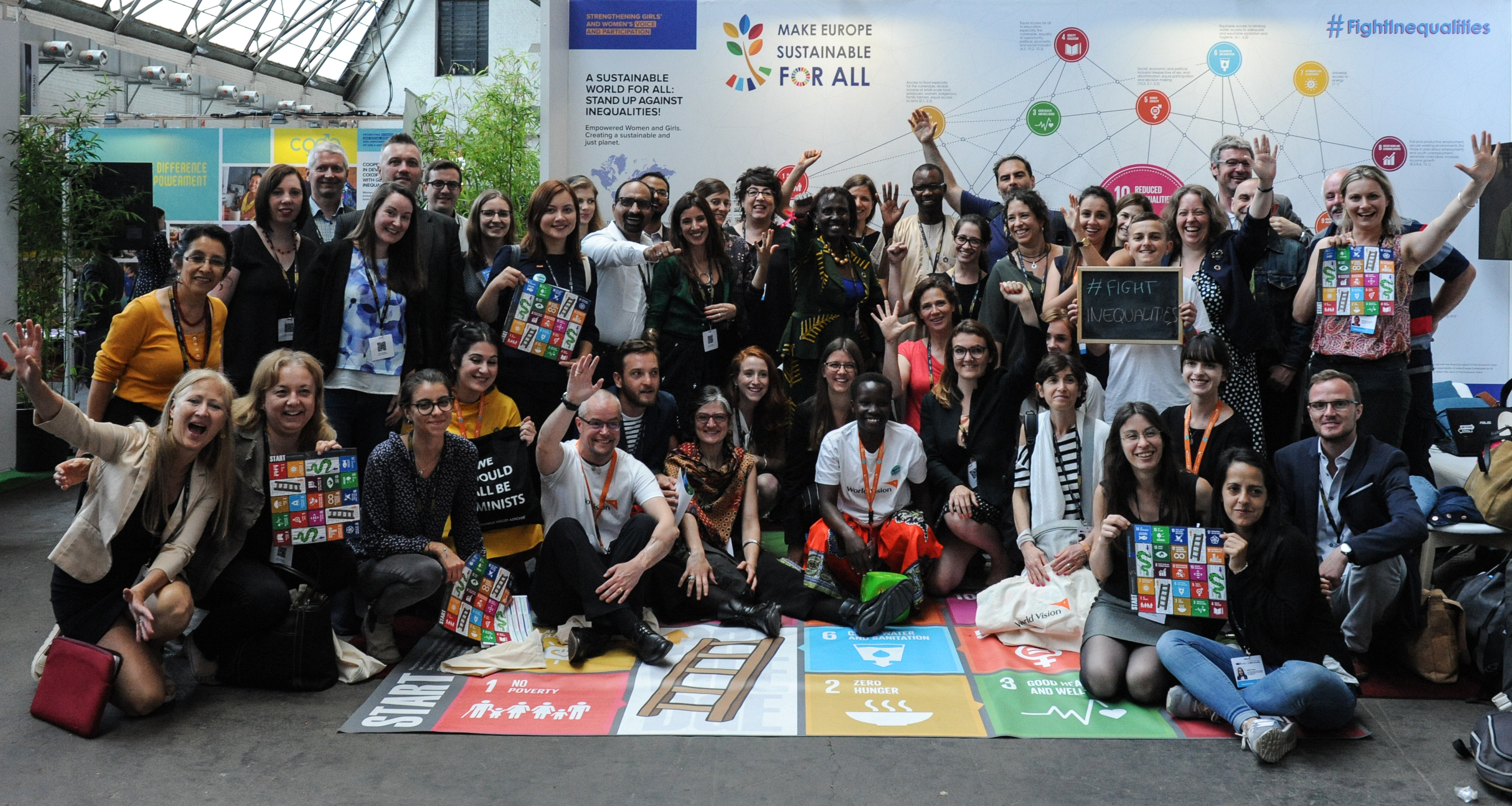
A new campaign kicked off during the European Development Days (5-6 June) warns that without action to curb global inequality, countries around the world won’t achieve the UN goals that aim to end poverty and protect the planet – the Sustainable Development Goals (SDGs).

The SDGs were adopted in 2015 and global leaders committed to achieving them by 2030.

The Fighting Inequalities Campaign  makes the case for societies to be more inclusive for women, children, different ethnic groups, marginalised people, and for EU citizens to become agents of change in their own communities.

“We need policies and laws that aim to make our societies inclusive for women, children, different ethnic groups, and marginalised people, and for EU citizens to become agents of change in their own communities. If political leaders don’t tackle the inequalities that arise as a result of the huge environmental and social injustices facing our world then the Sustainable Development Goals will be meaningless.” said Patrizia Heidegger, Director of Global Policies and Sustainability at the European Environmental Bureau – one of the NGOs behind the campaign.

The #FightInequalities campaign is part of the Make Europe Sustainable For All project which brings together NGOs that work on social issues, supporting farmers, stopping climate change, protecting the environment, defending women’s rights, young people, & gender equality, supporting fair trade, development, global justice, & workers’ rights.

See more about the campaign here!

Leaving development cooperation behind: is the EU turning its back on Agenda 2030?

By Global Health Advocates

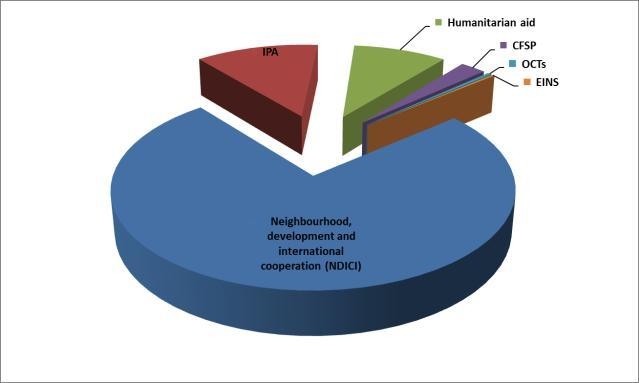
While many are rejoicing at the prospects of increased resources for external action in the face of Brexit, this is by no means justified. The proposal for a Neighborhood, Development, International Cooperation Instrument (NDICI) does not constitute an EU pledge to support partner countries’ efforts to “leave no one behind”.

Indeed, the proposal to merge 12 instruments from a wide array of policies – such as development, neighborhood, human rights and peacebuilding – into a single instrument de facto dilutes their distinct original objectives. This new instrument pledges to “uphold and promote the Union’s values and interests worldwide”. Read: member states’ economic and policy interests in partner countries. This means that the most vulnerable regions risk being left out at the expense of countries with strategic geopolitical interest.

This reconfiguration marks a major shift away from the EU’s principled and long-term approach to development cooperation. Agenda 2030 is clearly not the underpinning political framework for the EU’s future external action. And aid effectiveness principles are to be applied “when relevant”. But how and by whom will these judgments on relevance be made?

Clearly, the EU has lost sight of aid’s original purpose: addressing the root causes of poverty through substantial investments in areas like health and education. Rather, development aid is now considered a tool to leverage partner countries’ cooperation on matters linked to EU’s interests, such as security and migration. This – and not putting the EU’s political weight behind the Sustainable Development Goals – explains why the Commission proposes a much larger proportion of funds to be spent via geographical programmes.

Of course, foreign policy and development cooperation objectives do not inevitably clash, but there can be conflicts and the Commission provides no answers as to how they will be solved: who will set priorities, arbitrate between competing interests and ultimately decide? Who will control the resources?

These questions of accountability are all the more important as there is much more margin for interpretation planned under the new proposal: flexibilities for emerging challenges are being increased to 10% of the budget, and the Commission intends to allocate another 10% to migration, without detailing which specific areas will be prioritized. One should not overlook that EU elections are coming, that new Commissioners will be put in place and that polls for the progressive camp are all but promising. Therefore, too much flexibility risks pulling the EU further away from its principles and international commitments.

At the institutional level, things are even more unclear: how will responsibilities be shared between the EU External Action Service and DG Development? The same question goes for the European Parliament and the Foreign Affairs and Development Committees.

Many of our concerns align with the European Parliament’s recurrent positions. We therefore count on the Parliament to use all its power to drastically amend the single instrument and turn it into a Sustainable Development mechanism, and to clarify its governance, including priority setting. We also urge Member States to support an alternative proposal that is aligned with the Lisbon Treaty and conducive to the realization of the Paris agreement and Agenda 2030. The clock is ticking, and there won’t be a plan B.

Global Health Advocates is a non-governmental organization that focuses on engaging all sections of society to fight diseases that disproportionately affect people living in poverty, and are also the leading causes of people living in poverty. In particular, Global Health Advocates works towards the formulation and implementation of effective public policies to fight disease and ill health.  Established in 2001 as the Massive Effort Campaign, Global Health Advocates works in France and in India.

European Day of Sustainable Communities

By European Network for Community-Led Initiatives on Climate Change and Sustainability (ECOLISE)

The European Day of Sustainable Communities #EDaySC2018 on 22 September is a celebration of the efforts and achievements of the thousands of local communities across Europe who are taking action for a better, more sustainable world.

It is also about raising awareness among policy makers, at all levels – European Union, national, regional and local/municipal, of the scope and potential of community-led action on climate change and sustainability.

“We invite anyone who is working locally for a more equitable, sustainable, low-carbon society to help us celebrate the day by organising an event, however small, and registering it on our site,” says Eamon O’Hara, Executive Director of ECOLISE and the main organiser of #EDaySC.

Last year in 2017, groups of pioneering communities in 15 countries, from the Balkans to the Baltic Sea and along the western fringe of Europe, celebrated the first #EDaySC.

“In 2018 we want to build on this success. Already, at the end of May, communities in six countries had registered on our new website,”  says O’Hara.

Within the context of day, ECOLISE is also co-hosting a conference in Brussels ‘Citizens, communities and municipalities working together for grassroots climate action’ with the European Economic and Social Committee (EESC), in collaboration with Transition Network and the Committee of the Regions (CoR).

For further information please see:
www.sustainable-communities.net
@EDaySC
https://www.facebook.com/ecolise.eu/
iva.pocock@ecolise.eu

ECOLISE, the European network for community-led initiatives on climate change  and sustainability, is a coalition of national and international networks of community-led initiatives on sustainability and climate change, as well as organisations that support a community-led transition to a resilient Europe.

Citizens and sustainable development are big losers in EU’s next research programme

By Jill McArdle, Global Health Advocates

The European Commission has released its proposal for the next EU research framework programme, Horizon Europe, set to begin in 2020.

The proposal comes at a critical moment for the EU. Democracy across the EU is in a state of transformation. Shaken by recent electoral shocks, leaders are paying closer attention to the voices of citizens, and experiments in democratic innovation are taking hold in the public sphere.

Meanwhile, the Paris Climate Agreement and the Sustainable Development Goals have pushed global challenges to the top of the political agenda. This is thanks in no small part to civil society groups, who have campaigned tirelessly for decades on the need to radically transform our societies and set ourselves on a path to sustainable development within the planet’s boundaries.

Publicly funded research and innovation has a foundational role to play in addressing these challenges. It can offer an understanding of their nature, research alternatives to current models and support deliberation about possible conflicts and trade-offs. But to be effective, we must pay close attention to how the research agenda is set.

To ensure a needs-driven agenda, citizens must be at the centre of the process, both to reinvigorate democracy and harness the insights of those most affected by societal challenges. Civil society has an invaluable contribution to make here too, bringing its wealth of expertise and experience in areas like health and the environment, sustainable food and farming, climate and energy, and peace and democracy.

With this in mind, what has the EU proposed to do with the research budget? Zooming in first to the commitments on societal engagement, we see that engaging citizens and civil society in setting the research and innovation agenda is singled out as an objective of the programme. This is a positive move, though there are reasons to be cautious.

The concrete ways in which citizens will be engaged are left vague and undefined. And references to civil society are worryingly absent in the section supposedly dedicated to science and society.

Take a step back though, and the picture becomes even more concerning. The current proposal for Horizon Europe makes critical structural changes that could have catastrophic implications for democracy and sustainable development.

The current programme Horizon 2020 contains three pillars, focused on three distinct objectives: excellent science, industrial leadership and societal challenges (for example in health, food and climate). This coherent structure has been praised and reaffirmed at the political level and by numerous evaluations of the programme.

For Horizon Europe, the European Commission proposes to merge the second and third pillars of the previous programme under the heading “Global Challenges and Industrial Competitiveness”. This is a reckless move that puts research into real global challenges at risk.

What Horizon 2020 got right is that industry operates on a specific and distinct logic: profit and competitiveness. Societal challenges, on the other hand, focus on societal impact and therefore reflect the logic and interests of citizens and civil society.

We are told, of course, that these agendas naturally align. That these solutions to societal challenges are driven by the innovations of European industry. This may, in some cases, be true. But it is by no means a given that competitiveness will always be compatible with sustainable development.

And recognising that industry has a role to play is not the same as shoehorning the goal of competitiveness into a pillar meant to focus on the challenges faced by citizens and society. The key question here is, which goal will dominate? In the event of a conflict, what takes priority?

It is not hard to imagine how this will play out. Industry stakeholders are well-established within the programme. They know the programme well and how it works. They are well-equipped, well-resourced and well-organised. In comparison, citizens and civil society are not traditional actors in research and innovation.

They lack the insider knowledge and experience to effectively engage with the programme, as well as the resources needed to make themselves heard.

What chance has a needs-driven citizens’ agenda got against the might of industry? In this context, vague commitments on engaging society seem hollow and insufficient. At the level of societal engagement, a concrete roadmap to overcome barriers and boost engagement must be set out before the beginning of the next programme.

Structurally, a solution also presents itself. Horizon Europe will include a dedicated pillar for the European Innovation Council. Given that the EIC already integrates several elements of the Industrial Leadership pillar, and that their objectives are already closely aligned, this seems an appropriate place to house the remaining parts of Industrial Leadership.

This one move would preserve a dedicated pillar for independent research on urgent societal issues. We cannot afford to allow private interests to hijack a public research agenda intended to address citizens needs and deliver a just, equitable and truly sustainable future.

Global Health Advocates is a non-governmental organization that focuses on engaging all sections of society to fight diseases that disproportionately affect people living in poverty, and are also the leading causes of people living in poverty. In particular, Global Health Advocates works towards the formulation and implementation of effective public policies to fight disease and ill health.  Established in 2001 as the Massive Effort Campaign, Global Health Advocates works in France and in India.