News

SDG Watch Europe Online Plenary – 29th Nov. 2021

If you haven’t registered yet, please register here!

In response to the Covid-19 crisis, the EU has launched a recovery plan, the Next Generation EU (NGEU) fund, and other sub-instruments to help the EU move out of the Covid-19 crisis. Yet, the SDGs have played little of a role in these recovery plans and in the implementation of the Green Deal. The EU still lacks behind its commitments to take the SDGs seriously.

In our Fall Plenary, we would like to discuss with all SDG Watch Europe members what success and obstacles the SDG implementation and civil society work have faced in the last months. We will also elaborate on the strategy of SDG WE in the coming year and how to engage members.

Please join our next Virtual Plenary on 29 November 2021 from 12.30 to 16.00.

The Plenary will consist of 3 parts:
1) Panel Discussion with members of the European Commission and the European Parliament on Agenda 2030 and its integration in the European Semester
2) Analysis of SDG Watch Europe activities in the past months
3) Discussion on how to make the SDGs a priority in EU policies

Please find the programme and the link to connect in the document attached just below.

Online registration for the event is mandatory. Please register at the following link by 27 November 2021.

For more information, please contact secretariat@sdgwatcheurope.org

We are looking forward to a fruitful exchange!

ONLINE: Building Back Better: Towards achieving SDG 8 – 22. Nov 2021 15:00-16:30

By Caritas Europa

Caritas Europa is organising a webinar to assess how the EU and its Member States can advance towards achieving SDG 8, in the context of the COVID-19 recovery. This webinar will build on Pillar II of Caritas Europa’s Social Model on inclusive labour markets – work as a source of well-being and contribute to achieving a more human-centred economy.

Background:

For Caritas Europa, decent work (SDG 8), which respects the rights and dignity of every worker, is an essential part of a human-centred economy. However, decent work for all is still far from being achieved in Europe and the COVID-19 crisis has further worsened the labour market situation across the European States. COVID-19 has had severe socio-economic consequences, especially for those in vulnerable situations, and has impacted the progress many countries had been making with regard to decent work. In the context of the recovery, it is now more important than ever for the EU and its Member States to refocus on achieving SDG 8. What actions could be carried out now to help get us back on track toward achieving SDG 8 by 2030? These questions will be the focus of this webinar with input from people experiencing labour market hurdles, along with the Project Director of the SDG Index, the European Commission, Caritas Europa, and the dicastery for Integral human development.

Programme:

Moderator: Shannon Pfohman

15:00 – 15:10     Maria Nyman, Caritas Europa – Welcome and introduction

15:10 – 15:20     Professor Jeffrey Sachs, Columbia University – Assessment of the state of play on achieving SDG 8, especially following the outbreak of COVID-19.

15:20 – 15:35     Darvas Magdolna, Caritas’ Elderly Care Volunteer Programme and Hebrea Fernandez Bautista, A Todo Trapo Zaragoza – Presentation of their experiences related to employment/labour market

15:35 – 15:45     Cardinal Peter Turkson, Dicastery of Integral Human Development – Perspective of Catholic Social Teaching on the labour market and how to put it into practice.

15:45 – 15:55      Mirzha de Manuel, Member of Executive Vice President Valdis Dombrovskis’ cabinet – Presentation of the Commission’s work on implementing the SDGs at EU level and guiding the Member States towards implementation at national level.

15:55 – 16:25     Q&A

16:25 – 16:30     Wrap-up & conclusions

REGISTER HERE: https://bit.ly/3HIa1vY

SOLIDAR STATEMENT – COP26: Time to Put a Global Just Transition at the Centre!

By SOLIDAR (https://www.solidar.org/en/news/statement-cop26-time-to-put-a-global-just-transition-at-the-centre)

SOLIDAR strongly believes in the need and urgency for a transition towards climate neutral and more sustainable societies in Europe and all over the planet. However, we are convinced that the transition will only be successful if accompanied by real commitment and action, a clear timeline, as well as appropriate investment towards achieving social justice and the well-being of people. We also strongly believe that these processes should be done in consultation with civil society and the people they represent. This is the only way to create the necessary buy-in and acceptance from citizens for the transformations needed, and it is the just thing to do, because people living in vulnerable situations and poverty are disproportionately affected by the climate and environmental crises, despite being the ones that least contribute to it. They are also the ones paying the price of the transition, should policies remain the same. We must do everything in our power to change this. 

As highlighted by the European Parliament’s Resolution on the 2021 UN Climate Change Conference in Glasgow, “achieving climate neutrality goals requires massive investment and an unprecedented transformation of all sectors of our economies; This transformation towards a new sustainable economic model can only be achieved if it guarantees a just transition, which combines social and ecological progress, improves the well-being of people and leaves no one behind”. SOLIDAR agrees that delivering a Just Transition must start with re-shaping our economies to be more equal, inclusive, transparent, democratic, diverse, feminist, collaborative, circular, and sustainable.

Across the European continent, poverty rates and inequality levels in terms of access to universal social protection and other social rights are rising steeply, with millions of people finding themselves at risk of losing jobs, livelihood, and housing – if they have not already. Numerous forms of discrimination based on ethnicity, gender, disability, age and other grounds are still pervasive in Europe, and workers are faced with rising precariousness of work and inadequate working conditions. While reducing greenhouse gas emissions, the European Union and its Member States must tackle inequalities and the unequal access to human rights and essential services from an intersectional perspective, create a new world of work that offers decent, high-quality, decarbonised and sustainable quality jobs for all while strengthening social protection systems, and recognise the role and importance of formal, non-formal and informal education in the process of ensuring a Just Transition. 

The transition must benefit everyone everywhere. This means that climate action must improve the living and working conditions of all people and communities both in the Global South and in the North, to be truly just.  

We therefore call on all Parties involved at COP26 to put Just Transition at the centre. This should be pursued by: 

  • Recognising climate action as an indispensable instrument to reduce social injustice, generate opportunities for people in vulnerable situations and improve people’s wellbeing, quality of life, equality and access to rights. 
  • Upholding the principles of full inclusion and meaningful participation of civil society, trade unions and the most marginalised people in society, which are essential to a Just Transition.  
  • Increasing international climate and development finance and ensuring policy coherence for sustainable development. 

In relation to the Global South: 

  1. Early industrialised countries, with the EU at the forefront, must do their fair share of climate action and contribute to a fully inclusive Just Transition also in developing countries. We must guarantee due diligence and limit offshoring unsustainable production, always mindful that decisions made in the EU have direct consequences in other parts of the world. This recognition must characterise all policy as we are aiming to achieve the Sustainable Development goals (SDGs) by 2030. 
  2. Fully inclusive and appropriately funded international cooperation and full support and engagement for multilateral solutions are fundamental tools to support these transition processes globally. Climate finance should be new and additional to development finance and comprise equal levels of mitigation and adaptation finance, as well as new sources to address losses and damages. The target of at least $100bn in climate finance per year for developing countries should be met. All climate and development finance should be aligned with the Paris Agreement long term goals and the SDGs. 
  3. A fair global taxation system and debt cancellation in the framework of international mechanisms is paramount for developing countries to create the fiscal space they need to invest in their Just Transition.  

Further information on COP26: 

The 26th UN Climate Change Conference of the Parties, also known as COP26, is taking place from 31 October to 12 November 2021 in Glasgow, UK, and is hosted by the UK in partnership with Italy. COP is the supreme decision-making body of the United Nations Framework Convention on Climate Change (UNFCCC), the main intergovernmental treaty established to combat “dangerous human interference with the climate system”. The UNFCCC brings together 197 parties, including all UN member states, the State of Palestine and the European Union as a supranational union. At COP26, the Parties are mainly engaging in global negotiations to finalise the ‘Paris Rulebook’, the rules needed to implement the 2015 Paris Agreement, which set the goal of limiting global warming to well below 2, preferably to 1.5 degrees Celsius, compared to pre-industrial levels.

Circus Show on Migration/Climate Change in Brussels

By EEB (European Environmental Bureau)
29 October 2021  

TOUR & TAXIS – Eight artists and acrobats, four musicians, an impressive scenography and many stories to tell. After a tour of 10 European countries, the contemporary circus company MagdaClan is coming to Tour&Taxis in Brussels from 10 to 13 November to offer you an artistic experience full of reflections on migration and global warming.

With the support of the European Environmental Bureau and the Association of Local Democracy Agencies, the artists of MagdaClan want to engage the public in understanding the complex relationship between climate change and migration and create a movement of informed people ready to change their lifestyle and demand new development policies. 

They will stage a dramatic representation of the climate crises taking place in different corners of the world, posing as entire populations brought to their knees by floods, melting Arctic permafrost, desertification and fires. How will artists deal with these realities, with just a few objects and words?

Be part of the change!

Join us at Tour&Taxis on 10/11/12/13 November, 7.30pm, free, CST and registration required, link at the bottom.

More info on our Facebook event.
Register here
Share the event on Facebook
Check out the teaser

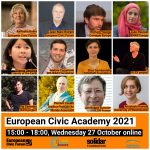
European Civic Academy 2021

Session III : All for a Better World, but All Fragmented? 

By Civil Society Europe

Co-organised with Civil Society EuropeSOLIDAR and Fundacja na rzecz Collegium Polonicum, the European Civic Forum invites you to join in Session III of  #EuropeanCivicAcademy 2021! 

This session will focus on the theme of Convergence: “All for a better world, but all fragmented?” and will take place on Wednesday, 27 October, from 3:00 to 6:00 p.m (CET) online.

The key issues to be tackled by both civil society activists and academic researchers are: 
⇒ Is convergence of democratic agendas the best path to systemic change? How to prevent from creating hierarchies of needs, issues and fights? Are there any attempts to connect/unite thematic agendas, to overcome fragmentation? What obstacles do they face? What can we learn from experiences of mutual contamination and convergence?

⇒ What are the relations between movements, organised civil society and other forms of democratic activism – conflict-cooperation, trust/mistrust? How are the different actors discussing this issue? Does this dialectic contribute to any contamination, debate or change between different concepts and practices towards a better world?

Don’t miss out on the opportunity to share your input in this event! 

For more information on the programme, click here.
Registration link: https://bit.ly/3n3IOKo

Deepened inequalities due to the COVID-19 pandemic

By Isabel Jerne (SDG Watch Europe)

The short-term wellbeing costs of COVID-19 have been severe. The pandemic is having profound effects on poor and marginalized groups, increasing poverty rates and widening gaps between different groups in society. SDG Watch Europe calls for urgent actions!

The pandemic has heavily impacted the progress in the fight against poverty putting our global goals at great risk. According to the World Bank, the pandemic is pushing between 88 and 115 million people into poverty because of the crisis. Almost half of the estimated new poor will be in South Asia and more than one-third in Sub-Saharan Africa. Objectively, COVID-19 has been the worst obstacle to reducing global poverty in the last three decades.

The pandemic is exacerbating the challenges faced by people struck by poverty. Inequalities are impacting the poorest, more vulnerable, and highly indebted countries of the world. Along with a health crisis, we are witnessing a worldwide hunger crisis. This is a global issue calling for solidarity by the most privileged countries, yet we are still to see real action being taken.

And what about other women, people with disabilities, older people, Roma communities, LGBTQI+, indigenous? How are they affected? These communities are being forgotten and left behind. The architects of systems that encourage greed and injustice do little to honor their commitments. 

Women have the biggest share in providing essential services (making up to 76% of healthcare workers in the EU), and assume the highest share of unpaid care work, with their rights being neglected. What is more, women are now at higher risk of domestic violence, while also having less power in decision-making processes.

UNICEF reported the story of a girl of Asian descent being constantly excluded and stigmatized. Yet discrimination goes beyond race. We’ve seen stories of LGBTQI+, migrants, refugees, and indigenous populations routinely facing discrimination. SDG Watch Europe calls for additional resources to protect these strata of society.

In the meanwhile, persons with disabilities have had their support systems suddenly disappear. Access to healthcare, food, and medicine has been problematic. This also concerns Roma communities, which experience a significant loss of livelihood, jobs, and child poverty. Lockdowns of entire Roma communities in Europe have hampered access to quality healthcare and prevention measures.

Older people with no access to vaccines are the most susceptible to serious cases of COVID-19. In fact, low-income countries have high mortality rates among elderly men.

Finally, 75% of all COVID-19 vaccine doses have gone just to ten countries. This is a vaccine apartheid, proof of the failure of current policy.

Leave no one behind” was pledged by UN Member States with the adoption of the 2030 Agenda. Yet, once again, this is one of those commitments that is not being respected, as minorities are literally being left behind, and treated with harsher measures than those imposed on the rest. At SDG Watch Europe, we have one clear command: Governments should keep their promises!

In our Covid Statement, we demanded that Member States would show transformative global action against poverty and hunger. We also called upon on the Commission to present an ambitious and comprehensive strategy for a Sustainable Europe 2030, which would aim at fighting poverty and inequality too.

We believe political attention must be placed on the protection of poor and marginalized communities. Social equity can – and must – prevail. Governments must put cash into the hands of people in the most need: migrants and refugees, LGBTQI+, disabled people, elderly people, women and unemployed people. 
“Beyond non-commitment” – the first Dutch SDG Spotlight

By SDG Spot Nederland (external resource)

The 17 Sustainable Development Goals (SDGs) were signed by all United Nations member states in 2015, the Netherlands included. The Dutch government has committed itself to realise these goals, at home and abroad, by 2030, leaving nobody behind.

With this first Dutch SDG Spotlight report titled “Beyond non-commitment”, we are joining other countries in keeping our government on track through an independent report, written by civil society organisations, about the state of the art of the SDGs. The SDG Spotlight report for the Netherlands was published in March 2021 and (partly) translated to English in June 2021. It critically assesses the Dutch policy approach to SDG 10 (Reduced inequalities) and SDG 15 (Life on land), showing the Netherlands’ approach to the SDGs is characterized by a high degree of non-commitment. Read the full SDG Spotlight report “Beyond non-commitment”

Spotlight on SDG10 and SDG 15 shows painful results

The Dutch 2020 Spotlight report focuses on SDG 10: Reduced inequalities and SDG 15: Life on land. These two goals represent two main areas of the SDG agenda: people and the planet. The results of the Spotlight report can be described as painful. The Dutch government’s policy on SDG 10 (reducing inequalities) and SDG 15 (life on land, biodiversity) are ambiguous and non-committal. The frame that The Netherlands is “doing pretty well” on the route to 2030, is not correct. In the area of social and ecological sustainability, the Netherlands is not making enough progress. To the contrary, the impact of Dutch policy is negative and does not bring the goals closer.

In the area of equal opportunity, diversity and social cohesion (SDG 10), the Netherlands is showing a mixed image, but the overall trend remains negative, especially for vulnerable groups. In the area of biodiversity, environmental protection and quality of the living environment (SDG 15), the Netherlands is simply falling short.

‘A high degree of non-commitment’

The Dutch government does make policies for a more sustainable economy, an inclusive society and corporate social responsibility, but the policy approach is characterised by a high degree of non-commitment. Good policy ambitions are not accompanied by measurable goals, adequate resources or clear legal frameworks. The government does not give enough guidance and direction to companies, which are given the space to regulate themselves and are not led towards a more sustainable production model with rules and pricing. Making international trade chains more sustainable is largely pursued through voluntary covenants. Time and again, we see that these approaches yield too few results.

Also, the government does not speak with one voice and its policy is not coherent. While one ministry or department develops policy that contributes to the SDGs, another department develops activities that have the opposite effect. Politics and actual implementation in practice give different signals, especially in the international and European context.

This way, we will certainly not achieve SDG 10 and SDG 15 by 2030.

Our goal: encouraging ambitious SDG action

The report examines the goals and indicators on the path towards the SDGs, something that has not been investigated for the Netherlands before. With this SDG Spotlight report on the Dutch role in achieving the SDGs, we want to encourage more ambitious and more coherent action on the SDGs. Our main conclusion is that it is high time for the Netherlands to translate the SDGs into an ambitious strategy with measurable goals for the national and international level. This strategy should be broadly anchored in all ministries.

Civil Society Convention for the Conference on the Future for Europe

CSOCoFoE: Thematic Cluster Consultations!
 
Dear Convention members,

As promised, we are now providing you with thematic cluster consultations to which you and your networks can contribute!

These consultations aim to bring a strong and shared agenda into public discussions on current social, environmental, and democratic challenges.

They represent the CoFoE agenda topics, and will result in report findings that will be presented to decision makers, media, and civil society across Europe, along with a joint preamble. Thus, we also invite you to involve your members in the following consultation processes:


 Our European Life Cluster Survey
Under the umbrella theme of “Our European Life” – What it is – What it should be – and How to Get There!, this cluster examine European rights and values as a transversal frame and foundation for pondering on these topics: European rights and values
Migration challenges and opportunities
EU’s role in the world
European identity
Freedom of movement
and more…


Factsheets that provide additional information and context concerning these questions are available here
Deadline for consultation: End of November.


    Democracy Cluster Survey 
Under the thematic cluster European Democracy we need – the survey aims to address concerns related to THREE main challenges of democracy in Europe: 

Enabling Environment for Participation
Electoral Reform
Ensure Accountability


For French version: https://forms.gle/HY2dvcKKjBhYDk1H8
For Italian version: https://forms.gle/VWALPWDBhftafMiFA

  Social Europe Cluster Survey    
CLICK HERE to write in your recommendations and positions with regards to the achievement of:

Sustainable Economic Model
Equal Opportunities (including migration)
Fair Working Conditions
Social Protection. 


Deadline for consultation: 26th of November.

   Digital Transformation Cluster Survey 
Via ECAS’s crowdsourcing platform share your positions on:

Digital Democracy
Digital Education
Digital Safeguards
Defending Rights and Freedoms Online
Digital Economy. 


Find the guidelines to access the platform at this link.
Deadline for the first phase of consultation: 31st of October.

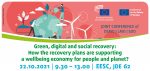
Green, digital and social recovery: How the recovery plans are supporting a wellbeing economy for people and planet?

Online event – EESC 22/10/2021 | 9:30 – 13:00 
 Green, digital and social recovery: How the recovery plans are supporting a wellbeing economy for people and planet? 
 On 22 October 2021, the EESC will hold an online event on ”Green, digital and social recovery – How the recovery plans are supporting a wellbeing economy for people and planet?”.
Europe is facing many challenges as a result of the pandemic of COVID-19. Crisis management and recovery is in the focus of the activities of the European Institutions and the Member States in 2021.

The three Observatories of the European Economic and Social Committee were following the negotiations of the new multiannual financial framework for 2021-27 and the Next Generation EU. It is crucial to ensure that recovery funding is sustainable as well as inclusive, and that it entails a ‘bounce forward’ for progress towards the Sustainable Development Goals (SDGs) and promotion of wellbeing-related goals, rather than a return to business as usual.

The main purpose of this event is to present and discuss about the involvement of civil society in the implementation of the recovery plans, through concrete examples. The event will focus on three economic sectors in transition to analyse the opportunities and challenges to shift towards a wellbeing economy, aligned with the SDG Agenda. The three panels on energy, car industry and digitalisation will have a regional kick off presentation of the underlying main drivers, potentials and challenges and will be based on concrete national experience. Each panel will allow time for contributions from participants.The programme is available here. This event contributes to the process of the Conference on the Future of Europe. Please register through this registration form. Registration is possible until Tuesday 20 October, 12.00 p.m. A link will be shared with registered persons before the event. 

Stop Excluding Military Pollution from Climate Agreements

By Actionnetwork

Target: Participants in COP26 UN Climate Change Conference, Glasgow, Scotland, November 1-12, 2021

COP26.info                  #NoWarNoWarming

We encourage individuals and organizations to sign the petition below, and also ask organizations to sign a similar petition created by Conflict and Environment Observatory here.

We encourage groups and individuals to organize events to advance this message on or about the big day of action in Glasgow on November 6, 2021. Resources and ideas for events are here.

PETITION:

To: Participants in COP26 UN Climate Change Conference, Glasgow, Scotland, November 1-12, 2021
From: [Your Name]

As a result of final-hour demands made by the U.S. government during negotiation of the 1997 Kyoto treaty, military greenhouse gas emissions were exempted from climate negotiations. That tradition has continued.

The 2015 Paris Agreement left cutting military greenhouse gas emissions to the discretion of individual nations.

The UN Framework Convention on Climate Change, obliges signatories to publish annual greenhouse gas emissions, but military emissions reporting is voluntary and often not included.

NATO has acknowledged the problem but not created any specific requirements to address it.

There is no reasonable basis for this gaping loophole. War and war preparations are major greenhouse gas emitters. All greenhouse gas emissions need to be included in mandatory greenhouse gas emission reduction standards. There must be no more exception for military pollution.

We ask COP26 to set strict greenhouse gas emissions limits that make no exception for militarism, include transparent reporting requirements and independent verification, and do not rely on schemes to “offset” emissions. Greenhouse gas emissions from a country’s overseas military bases must be fully reported and charged to that country, not the country where the base is located.